When Metricool released their 2026 LinkedIn study earlier this year, I did what I usually do with a substantial research report: read it carefully, pull out the findings most relevant to my clients, and share them with my audience.
The study was based on an analysis of 673,658 posts across 63,108 accounts, and most of the conclusions made sense…
- Personal profiles outperform company pages on engagement.
- Carousels generate significantly more interactions than images.
- Posts that include a question get more comments.
You know, useful, evidence-based stuff that aligned broadly with what I was already seeing in client data.
But one finding raised an eyebrow 🤨
According to Metricool, company page posts that include a link get 51% more impressions and 41% more interactions than posts without one.
But this contradicts one of the most widely known ‘facts’ in LinkedIn marketing, that including a link suppresses your reach because the platform wants to keep users on-site rather than clicking away. I’d been advising clients on this basis for years, and so had most of the other LinkedIn experts I know.
I shared the finding on my socials and asked my audience what they thought.
The comment section had questions
The post shared ten findings from the Metricool study, but the links stat was the one that other people queried too.
Relentlessly helpful LinkedIn expert, John Espirian, said: “Some of these stats feel very counter-intuitive but I don’t have enough data to challenge them. I’m not a big user of company pages but this doesn’t at all match my experience.”
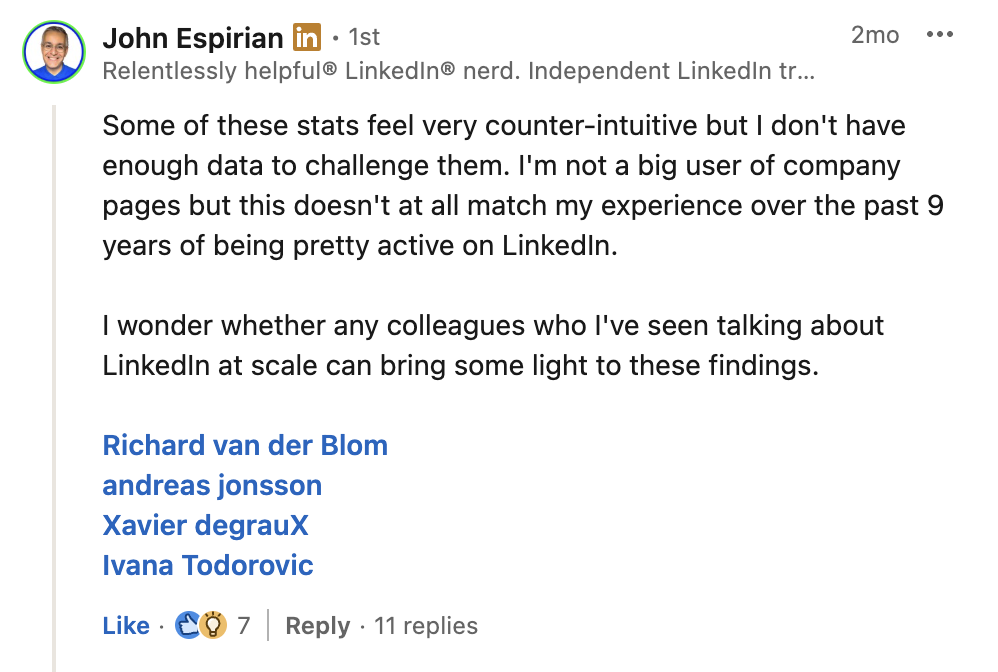
He tagged several other LinkedIn experts to weigh in, including Ivana Todorovic, who pointed out a new angle I hadn’t considered.
Ivana raised the question of employee reposts. She pointed out that a significant proportion of company page interactions, particularly shares, come from employees rather than people who discovered the content organically. She said: “More than 90% of responses come from employees, not from people who were interested in the content.”
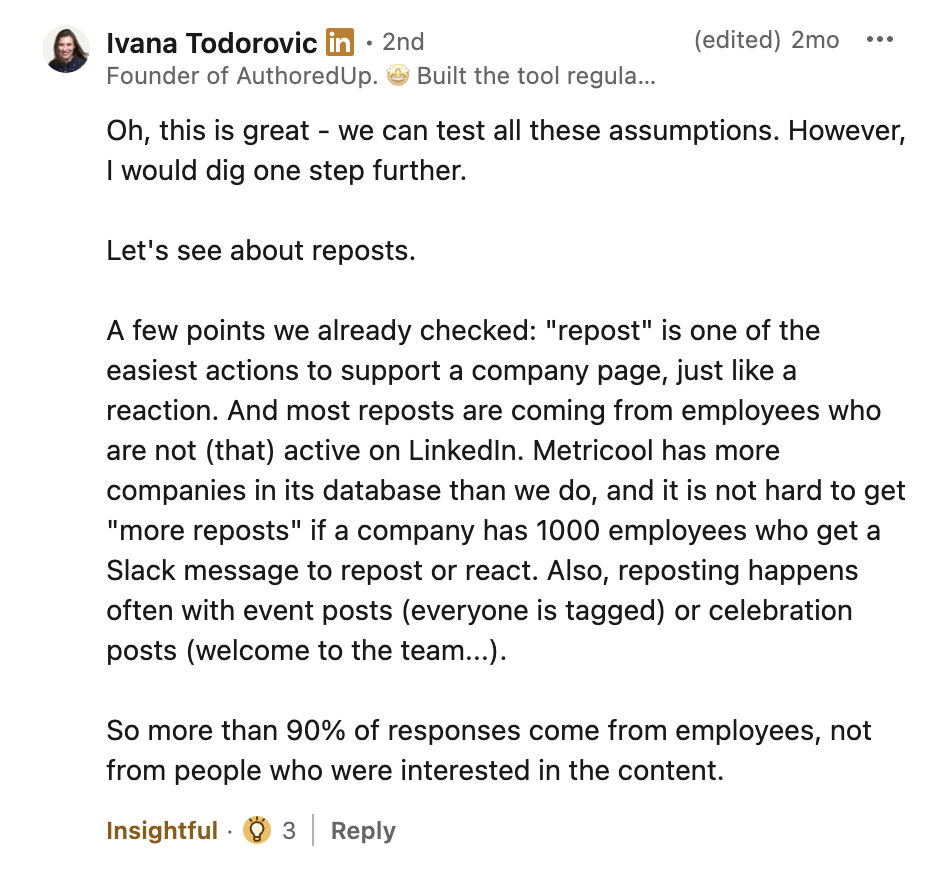
It was a great point. Company page engagement, measured as an average across all accounts, might look very different once you strip out the internal amplification from large organisations with lots of employees hitting reshare.
Copywriting and brand voice virtuoso, Mel Barfield, said the company pages findings were “in direct contrast” to what she’d found personally. Marketing consultant, Kate Chidzik, said she wasn’t buying the links finding either. She wrote: “I’d be interested to see if anyone has any data.”
So obviously, I said I’d go and find some…
Testing it against real client data
I pulled six months of LinkedIn data from two of my clients via my own Metricool account: a B2B tech company and a local government service. I compared the performance of posts with and without links across every available metric.
The results were clearer than my five year old’s opinion on Brussels sprouts.
For the B2B tech client, posts with links had 62% fewer reactions, 82% fewer comments, and 90% fewer clicks than posts without. For the local government service, the engagement rate on link posts was 46% lower, and link posts underperformed across every single metric measured. Not one exception in either account.
This directly contradicted the Metricool finding.
I shared the results publicly, crediting the sceptics who had prompted my investigation. John Espirian summed up the broader concern neatly: “If people trust the insight that Metricool has shared here, they will now be flocking to add more links to their posts. Something tells me that they won’t be doing that.”
Kate Chidzik offered a compelling theory. She wondered whether the accounts driving Metricool’s result might be more B2C-oriented. “Metricool is huge with Instagram and Facebook businesses and solopreneurs who might recently have come over to LinkedIn,” she wrote. “It would be interesting if they’d share a segment split chart around their data source.”
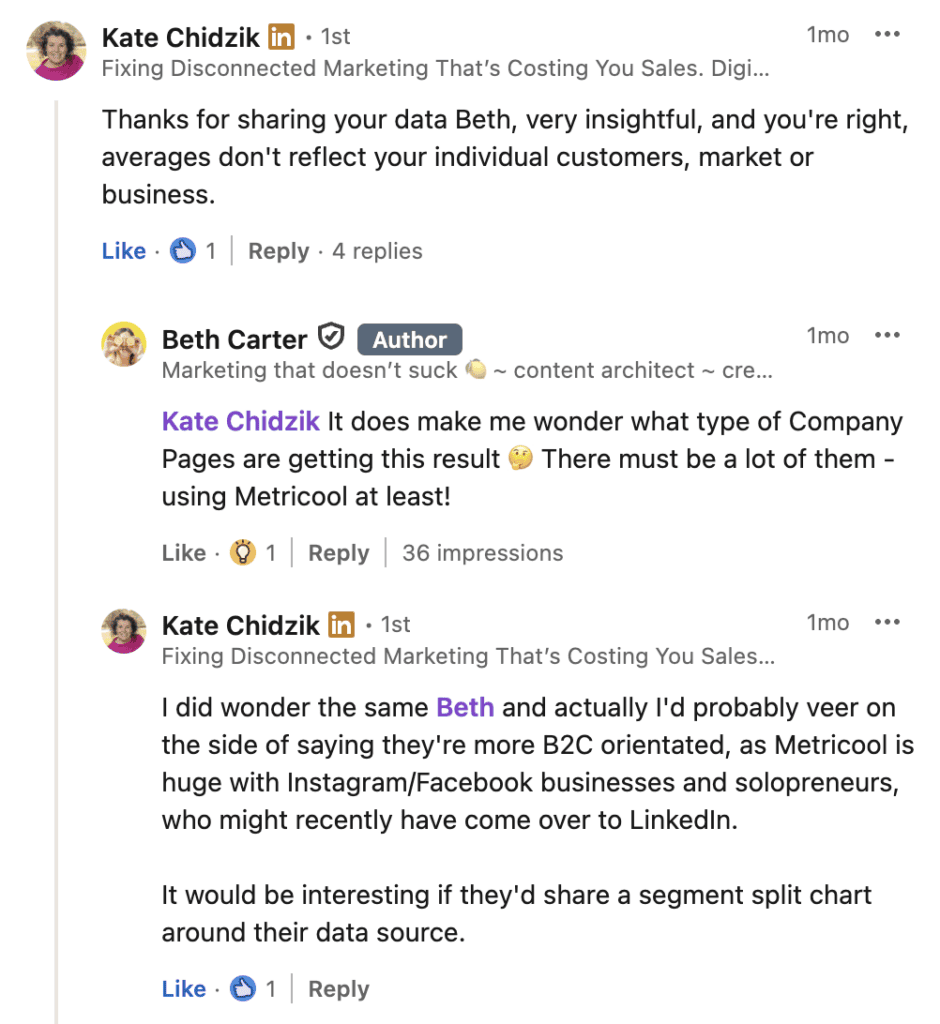
It was a smart observation. Metricool’s dataset covers 63,108 accounts from every industry and audience type on the planet. An average across that sample doesn’t automatically apply to any individual page, audience, or content type.
So I tried to contact Metricool directly to ask for more context. Their support team said they couldn’t help. I tagged them publicly in a comment with my email address. There was no response.
For a while, the investigation went cold… 🕵🏼♀️
A second report and a new theory
Then Metricool released ANOTHER REPORT 🙌 This one was produced in partnership with creator intelligence platform Favikon, titled LinkedIn in 2026: The People-Powered Brand Playbook.
I didn’t have high hopes that it would contain what I was looking for, but two details caught my attention.
The first was on page 21, where they recommend a specific workflow for company pages: post content natively on a personal profile with no outbound link, then reshare it from your company page with the link attached. So I thought maybe if posts like these made up a meaningful chunk of the “posts with links” in their dataset, the 51% figure would make more sense, since a reshare rides the momentum of an already-performing post. On reflection, though, this was speculative. The workflow is just a recommendation, not evidence of what their dataset actually contains, and I’ve since set that theory aside.
The second detail, from Metricool’s methodology section on page 41 of the study, is more solid. LinkedIn counts clicks as interactions for company pages in a way it doesn’t for personal profiles. A link post that gets clicked but never liked or commented on can register as high engagement in the data while looking completely flat by other conventional measures.
Of course, I also posted about this on LinkedIn.
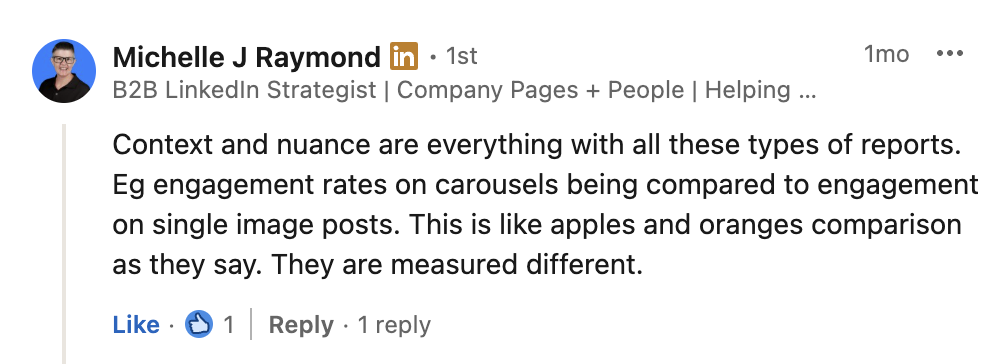
LinkedIn company pages expert, Michelle J Raymond, responded to point out that engagement rate measurements also vary on different post types. She said: “This is like apples and oranges comparison as they say. They are measured different.”
Then Metricool actually responded, twice!
After I published this update, Metricool replied in the comments: “After analysing 65K accounts across many industries, one thing stood out: audiences behave very differently. For example, people in mining and oil often value links to reports, regulations, and industry information. That may go against common social media belief, but there’s no one-size-fits-all approach. Benchmarks are useful reference points, but no one knows your audience better than you do.”
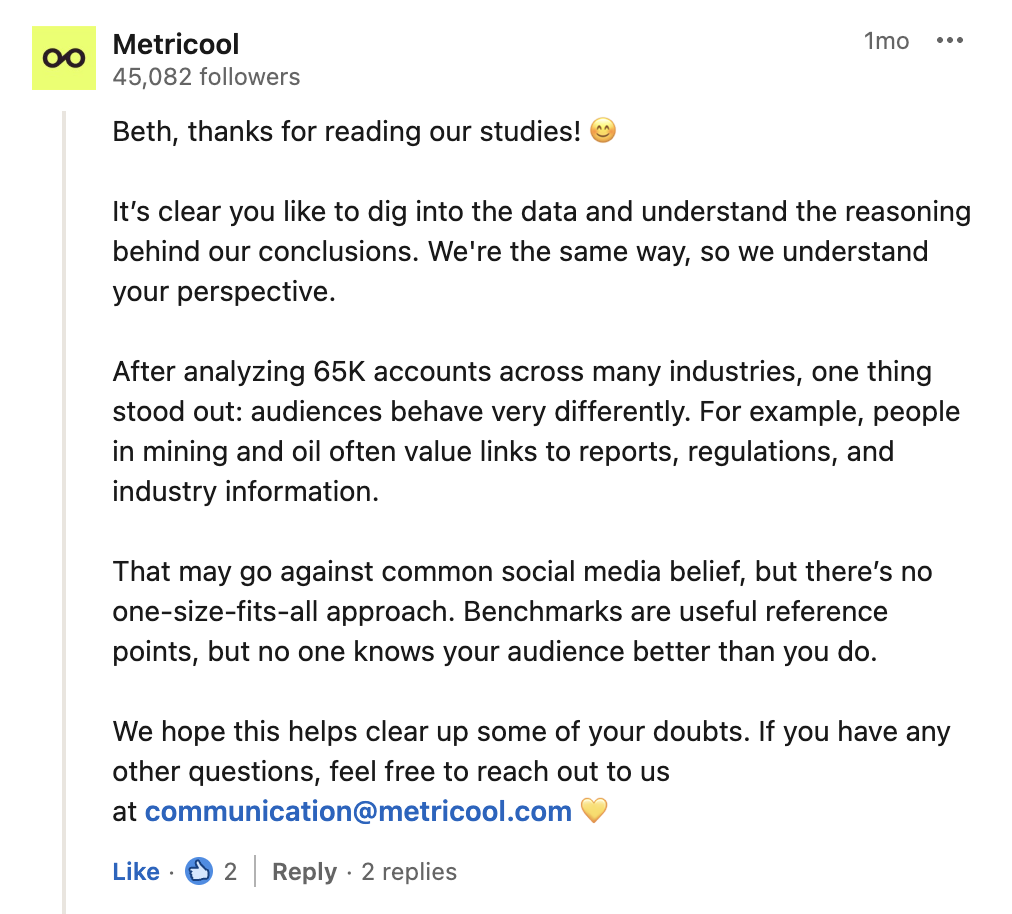
It was a diplomatic response, and I suspect the person writing it had limited latitude to share more granular detail. But it confirmed that audience behaviour around links varies significantly by industry, and the aggregate average blends all of that variation into a single number.
I thanked them and suggested an industry breakdown of the links finding for their next report.
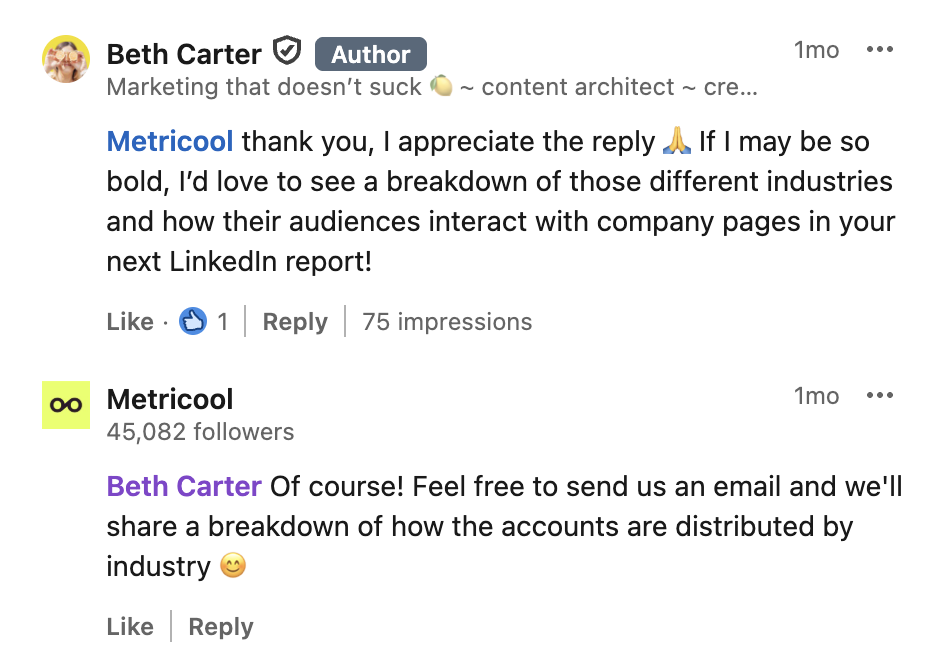
So I emailed them. Then David Bustos Fernández, the person leading studies and reports at Metricool, responded to my email directly 🙌
He confirmed that the links figure is an overall comparison between posts with a URL in the caption and posts without one, with no industry breakdown behind it. So he also shared the industry distribution of their entire sample.
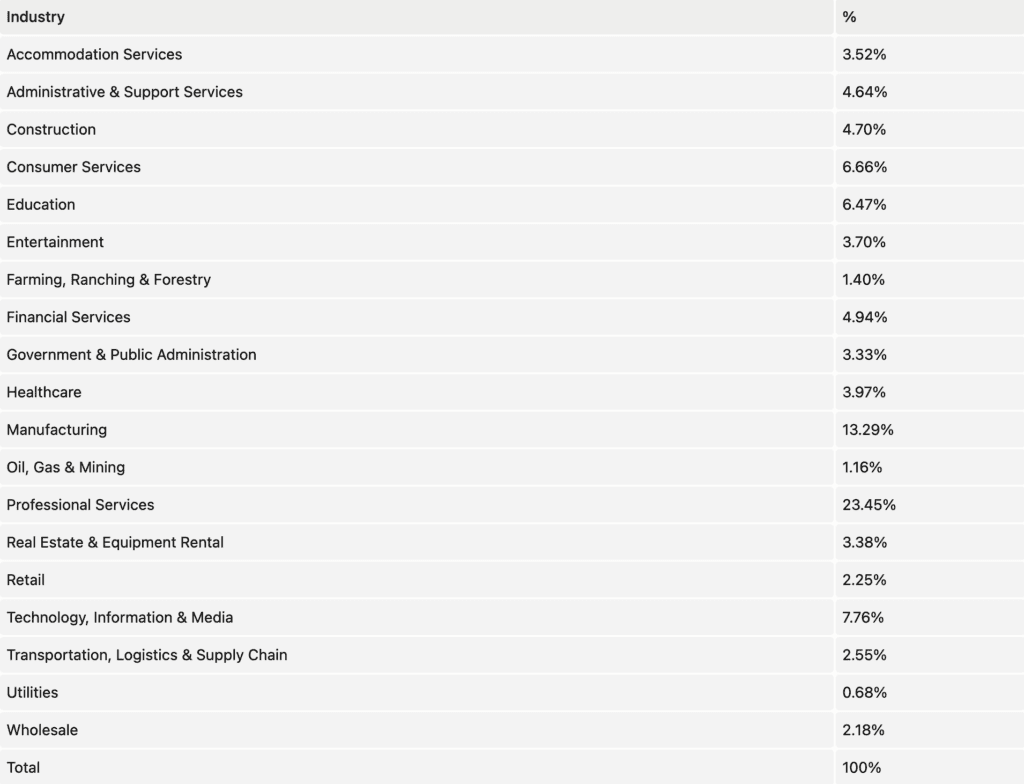
The dataset spans 19 industries in total. Professional Services is by far the largest slice at 23.45%, followed by Manufacturing at 13.29%, Technology, Information and Media at 7.76%, and Consumer Services at 6.66%. Education accounts for 6.47%, Financial Services for 4.94%, and Construction for 4.70%. At the other end of the scale, Oil, Gas and Mining represents just 1.16% of the sample, with Utilities the smallest of all at 0.68%.
It was clear, looking at these, that the positive links findings can’t be explained away by one link-hungry niche industry dominating the data. The sample is heavily weighted towards professional services, but that’s the very sector where my own clients saw links underperform across the board.
So the question I’d been asking all along, which industries or content types are driving the uplift, remains open.
David promised they’d keep the industry angle in mind for the next study and would dig into LinkedIn’s industry data further.
So what does this all add up to?
The conclusion is that the Metricool finding is probably real in aggregate. But aggregate data across 673,658 posts from every industry and audience type on LinkedIn will always flatten the nuance that actually matters to your specific page, your specific audience, and your specific content.
My clients in professional services saw the opposite result. Yours might too. Or they might not (sorry 😂).
The most evidenced explanation I have for the gap is the click counting methodology. Because LinkedIn factors clicks into company page engagement, and link posts naturally attract clicks, the headline stat may be measuring a kind of engagement that never becomes visible on the post itself. Whether that fully accounts for the 51% figure, I can’t say for certain. The industry question stays open until Metricool’s next study.
Which brings me to the only advice worth giving on this topic. If sharing links is an essential part of your company page content strategy, don’t assume the headline stat applies to you, and don’t assume it doesn’t either. Test it. And when you test it, think carefully about how you’re including those links, because not all link posts are the same.
Different ways to include links in your company page content
The way you include a link matters as much as whether you include one at all. Here are the main options worth testing:
Allow the metadata preview to display automatically.
This is the default approach: paste a link into your post and let LinkedIn pull through the preview image, title and description. It’s the easiest option but often the least visually appealing, particularly if the thumbnail is small or the metadata is poorly optimised.
Include a link with a custom image.
Remove the auto-generated metadata preview and replace it with a properly designed image. This tends to perform better than the default preview and provides the branding consistency you’d want for a company page.
Include a link with a video.
The same principle as above, but with video instead of a static image. Video generates reasonable engagement, so pairing it with a link gives you visual interest without relying on metadata.
Post text only and remove the metadata preview completely.
If the link itself is the point, you can include it in the caption as plain text with no preview at all. This keeps the post clean and removes the visual clutter of a preview that may not look great, though it does put more weight on the copy to make people want to click.
Add the link as a first comment rather than in the post body.
A widely used tactic, particularly on personal profiles, based on the theory that keeping the post body link-free protects reach while still making the link accessible. The evidence on whether this actually works is mixed, and Metricool’s own data doesn’t specifically address it, but it’s always worth testing.
Direct people to your bio or featured section instead.
Rather than including a link in the post at all, you could reference it in the caption and direct people to your company page bio or featured links. This keeps the post itself link-free while still making the destination accessible to anyone who wants it.
The right approach depends entirely on your audience, your industry, and what you’re trying to achieve. And it’s also worth noting that, depending on your industry and goals, sharing links may not need to be part of your company page strategy at all. That’s a test worth running too.
I hope this has been helpful, and if you have any thoughts, I’d love to hear from you!